How to Start Trading Forex
A practical, no-hype guide that treats Forex like a skill — not a lottery ticket.
Start here: the reality check
So, you want to trade Forex? Welcome. Pull up a chair — and let’s start by clearing the fog.
If you found your way here through social media, you’ve probably seen the usual “I made $10,000 before breakfast” clips. I’m not saying nobody ever has a big day. I’m saying you should build your expectations around what’s repeatable. This isn’t a slot machine. It’s closer to learning a craft: messy at first, slower than you want, and surprisingly psychological.
Here’s the deal: The market doesn’t pay you for being excited. It pays you for being consistent.
That means learning the basics, managing risk like a professional, and keeping your ego out of the driver’s seat.
The basics: what are we actually doing?
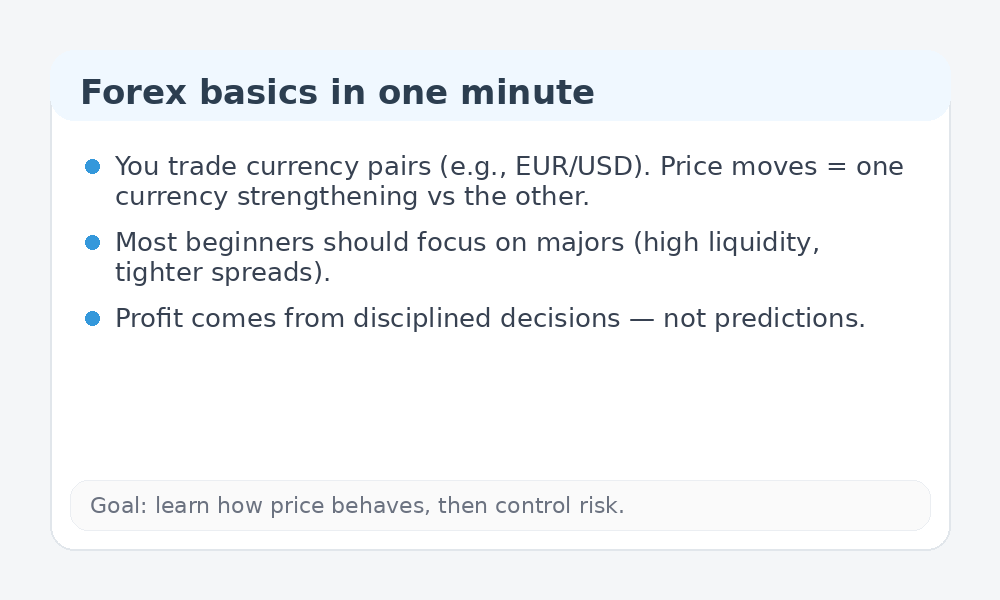
At its core, Forex (Foreign Exchange) is about relative value. You’re comparing two currencies and taking a position: one goes up versus the other, or it doesn’t.
If you buy EUR/USD, you’re effectively saying: “I think the euro will strengthen against the U.S. dollar.” If EUR/USD rises after you buy, you profit. If it falls, you lose. Simple concept — complicated execution.
Mini glossary
- Pip: The standard unit of movement (varies by pair and pricing).
- Spread: The difference between buy (ask) and sell (bid). It’s one way brokers get paid.
- Leverage: Borrowed purchasing power. Helpful and dangerous — like a chainsaw in a kitchen.
- Stop-loss: A pre-set exit that limits damage when a trade goes wrong.
- Lot size: The trade size. This determines how much you win/lose per pip.
The “secret” most beginners miss is that trading isn’t about predicting every move. It’s about managing a series of bets where you control losses and let the math work in your favor over time.
Step 1: The setup – choosing a broker and platform
Your broker is your gateway. That means two things: (1) they matter, and (2) you should be picky. There are good brokers out there — and there are brokers that make their money from clients blowing up.
Broker checklist (print this mentally)
- Regulation: Prefer brokers regulated by strong, well-known authorities.
- Transparent fees: Clear spreads/commissions, swap rates, and deposit/withdrawal policies.
- Execution quality: Slippage happens, but it shouldn’t be consistently “mysteriously” worse for you.
- Reasonable leverage: More leverage is not “better.” It’s just more rope.
- Support + withdrawals: If withdrawals are slow or support is evasive, treat that as a flashing red light.
Platform-wise, most retail traders start with MetaTrader 5 (MT5). It’s not pretty, but it’s reliable, widely supported, and it has a huge ecosystem of indicators, scripts, and automation tools.
Step 2: The insider secret – stop overpaying
Trading has friction. Every time you enter and exit, you pay something — usually through the spread or a commission. If you’re active, those costs can quietly become one of your largest “expenses.”
One common way traders reduce effective costs is by using a rebate service like cashbkfx.com.
Think of it like cashback on trading volume. If you open your brokerage account through a rebate partner, part of the broker’s referral fee may be shared back to you based on how much you trade.
Important: rebate programs don’t guarantee profits and shouldn’t change your risk rules. They’re a cost-reduction tool, not a strategy.
Even if you break even on your trading, a small reduction in friction can meaningfully improve your long-term results. Just make sure you read the terms and understand how/when rebates are paid.
Step 3: Essential tools of the trade
Trading with only a chart is like trying to get fit without ever stepping on a scale. You need tracking, feedback, and a way to see your habits clearly (especially the ones you’d rather ignore).
1) Myfxbook.com
A performance dashboard that can connect to your trading account and show you your real stats: drawdown, win rate, average win vs. loss, best/worst days, and more.
The big benefit is honesty. Our brains conveniently forget pain. A tracker doesn’t. If someone is selling you signals or a course, a verified track record (and a healthy skepticism) matters.
2) MQL5.com
If you use MT5, MQL5 is the main ecosystem for indicators, scripts, and “Expert Advisors” (automation). It’s where you explore tools that can help you test ideas, enforce rules, or copy signals (with care).
Automation can reduce emotional mistakes, but it can also automate bad ideas faster. Start simple, test everything, and don’t trust marketing screenshots.
One more tool you should use: a trading journal
Not fancy. Just consistent. Record: why you entered, where your stop was, how you sized it, what you felt, and whether you followed your rules. If you do nothing else, do this — it’s the shortest path to improvement.
Step 4: Find your tribe (forums worth your time)
Trading can be lonely. That’s a feature and a bug. You don’t want groupthink, but you do want perspective. The right communities can help you learn, spot scams, and avoid repeating mistakes that other people already paid for.
- Forex Factory: The economic calendar is a staple. Forums can be high signal — with the occasional grumpy veteran (don’t take it personally).
- BabyPips: Beginner-friendly education (“School of Pipsology”) and a welcoming community.
- Forex Peace Army: Useful for broker/service reviews and scam investigations. Research before you deposit anywhere.
- Trade2Win: Broad trading discussions beyond Forex too — helpful for widening your lens.
Step 5: Developing a strategy (the “boring” part that makes money)
A strategy is not “I feel like it’s going up.” A strategy is a repeatable set of rules: when you enter, where you get out if wrong, where you take profit, and how much you risk.
The two big approaches
- Fundamental analysis: You trade based on macro drivers (rates, inflation, jobs data, growth expectations).
- Technical analysis: You trade based on price behavior (support/resistance, trends, ranges, patterns).
Most real-world traders blend the two. For example: you may prefer a technical entry, but you avoid trading right before major news. That’s not “being afraid.” That’s being professional.
A simple “starter” strategy idea (not a promise, just a structure):
- Pick 1–2 major pairs (EUR/USD, GBP/USD, USD/JPY are common).
- Trade one timeframe consistently (e.g., 1H or 4H) so you’re not switching personalities mid-week.
- Define a trend filter (e.g., higher highs/higher lows) and an entry trigger (e.g., pullback to a key level).
- Use a stop-loss placed where your idea is clearly invalid — not where your emotions feel comfortable.
- Journal every trade for 30 days before changing rules.
Risk management (the part that keeps you in the game)
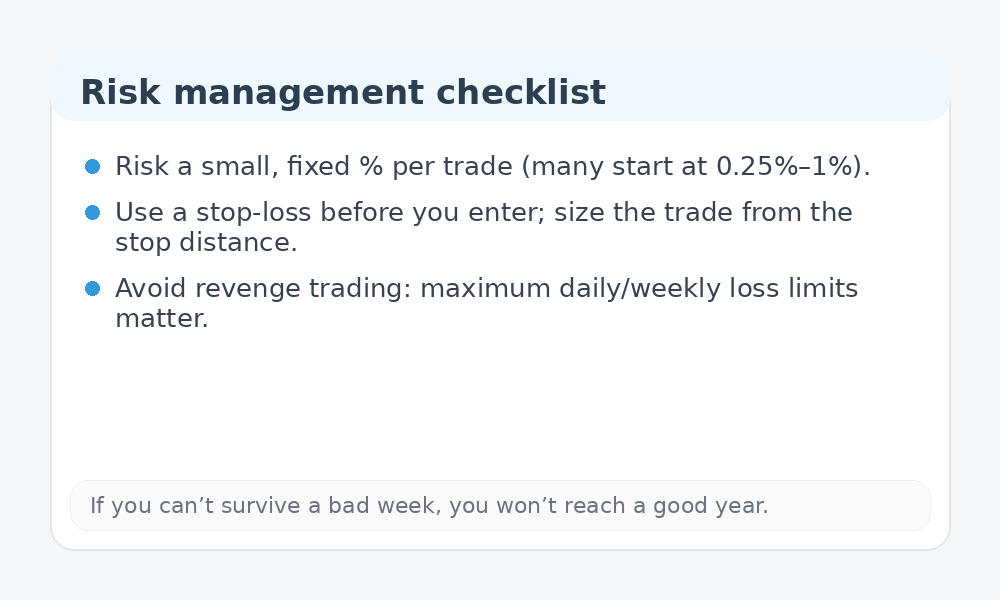
If you only remember one thing from this article, make it this: risk is the steering wheel. Without it, you’re not “trading,” you’re just sliding around on ice and hoping for the best.
The golden rule
Many experienced traders risk about 1% to 2% of their account per trade. That means if you have $1,000, you plan to lose $10–$20 if your stop-loss is hit.
Why this matters: if you risk 10% per trade, a short losing streak can end your trading career. If you risk 1%, you can be wrong many times in a row and still survive long enough to learn.
Three rules that save accounts
- Always use a stop-loss. Not “mental.” Not “I’ll close it if it gets bad.” A real stop.
- Size your trade from the stop-loss. Stop distance first, lot size second. Not the other way around.
- One bad day should not become a bad month. Have a daily loss limit (e.g., 2–3 losses and you stop).
Step 6: The transition from demo to live
Demo accounts are useful for mechanics and practice, but they lie emotionally. Losing fake money doesn’t hurt. Losing real money changes your breathing, your decision-making, and your patience.
Best move for beginners: when you go live, trade smaller than you think you should.
You’re not trying to get rich. You’re training your nervous system to follow rules under pressure.
If you have $5,000 set aside, consider starting with a smaller portion (for example, $500) and scale only after you’ve proven consistency. Scaling is a reward for discipline — not confidence after a lucky week.
A simple weekly routine for beginners
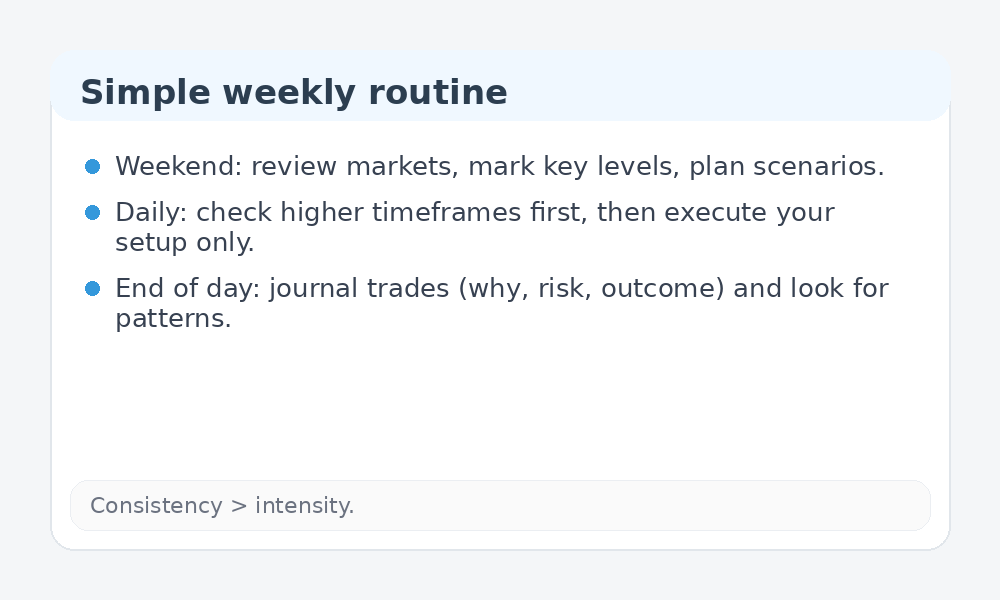
The fastest improvement usually comes from doing the basics consistently. Here’s a routine that keeps you grounded:
- Sunday / Monday: Review the economic calendar (big rate decisions, CPI, jobs data).
- Daily (10–15 min): Mark key levels on your chosen pairs. Decide your “if/then” plan.
- During trading: Only take trades that match your rules. No “just this once.”
- After trading: Journal the trade (setup, entry, stop, size, emotion, rule adherence).
- Weekly review: Look for one fix. Not ten. One. Then apply it next week.
Common beginner mistakes (and how to avoid them)
- Overtrading: More trades ≠ more skill. Usually it’s just more fees and more emotional whiplash.
- Changing strategies every week: You never collect enough data to know what works for you.
- Moving the stop-loss: That’s not “giving it room.” That’s negotiating with the market.
- Chasing losses: Revenge trading turns a normal loss into a catastrophe. Step away.
- Ignoring costs: Spreads and commissions matter. Treat them like business expenses.
- Following strangers blindly: Learn from others, but keep responsibility for your own risk.
FAQ
How much money do I need to start?
You can start with a small amount, but you need enough that proper position sizing is possible. The real answer is: start with what you can afford to lose while you learn — and keep risk per trade small.
Can I trade Forex as a side hustle?
Yes, if you choose a timeframe that matches your schedule. Many part-time traders prefer higher timeframes (like 4H or Daily) so they don’t have to watch every tick.
Is copying signals a good idea?
It can be, but treat it like hiring a contractor: verify their history, understand their drawdowns, and keep risk low. If you don’t understand how the strategy wins and loses, you won’t know when it’s failing.
What’s the “best” strategy?
The best strategy is the one you can follow consistently, with risk controlled, through both winning and losing streaks. A good strategy on paper is useless if you can’t execute it.
Final thoughts
Forex trading can offer flexibility and independence — but you have to earn it. Treat it like a business: reduce unnecessary costs, track performance, learn relentlessly, and protect your capital like it’s oxygen.
Use tools like Myfxbook to stay honest, explore the ecosystem on MQL5 if you use MT5, and lean on quality communities when you’re stuck. If a rebate program like cashbkfx.com fits your setup, it can reduce friction — just keep it in the “expenses” category, not the “edge” category.